Kevin G. Chapman

Author and Speaker
ABOUT
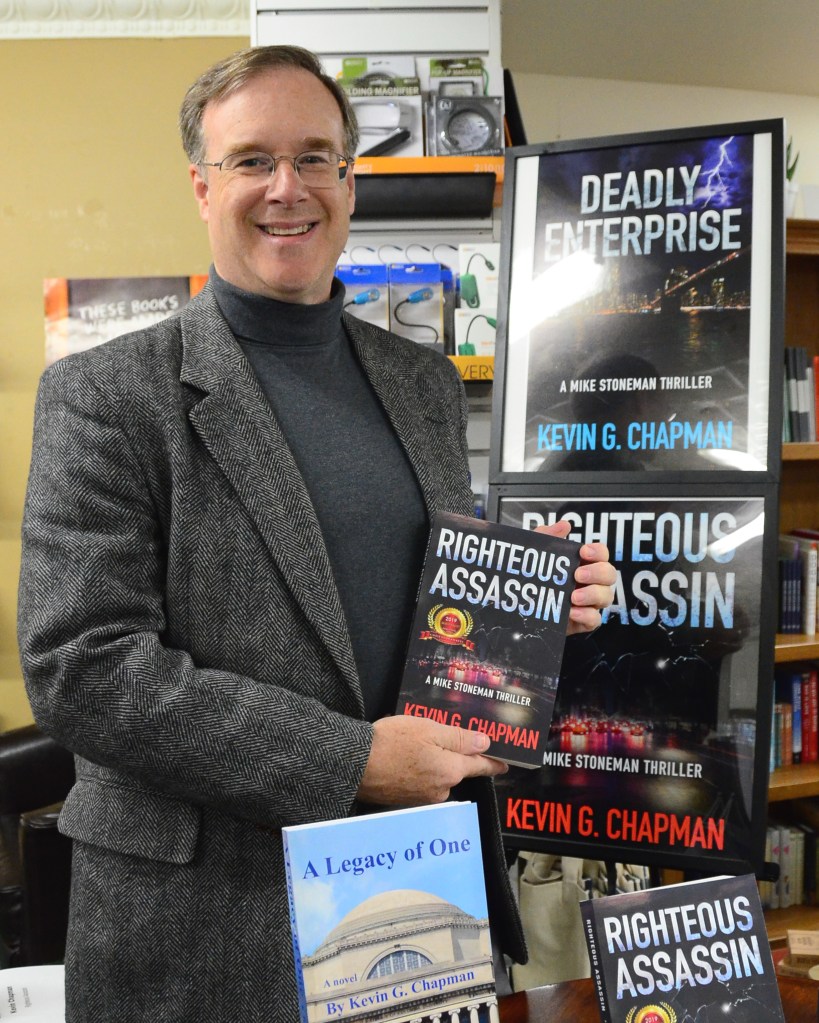
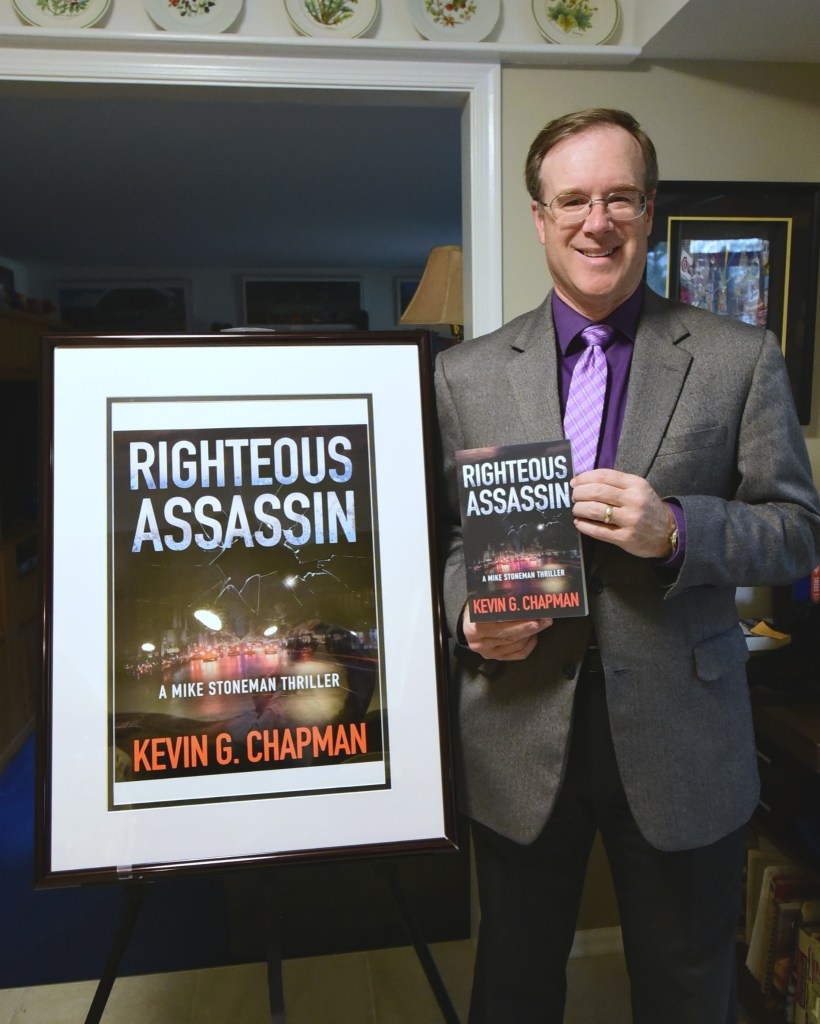
Kevin G. Chapman is a corporate labor & employment attorney, but you’re more interested in him as an author. Kevin has written both serious literary fiction and crime-thrillers. His Mike Stoneman Thriller series features NYPD homicide detective Mike Stoneman and his younger partner, Jason Dickson. The six books (so far) in the series range from a serial killer chase to a murder aboard a luxury cruise ship to the investigation of the possibly racist-motivated murder of an NFL Quarterback to the murder of a Las Vegas drag queen. Kevin has more recently written two stand-alone mysteries — Dead Winner and The Other Murder.
Kevin’s novels have garnered multiple literary awards, including the 2021 Kindle Book Award (Lethal Voyage, Mike Stoneman Thriller #3), the CLUE Grand Prize (The Other Murder), and twice the Blue Ribbon “best in category” wins at the CLUE Awards (Fatal Infraction, Mike Stoneman #4 (best police procedural) and Dead Winner (best suspense/thriller)).
Kevin is an independently published author and is happy to talk about the writing process, the indie publishing world, and the challenges (and joys) of self-publishing and self-narrating his audiobooks. He also publishes book reviews on his blog and loves talking about other authors, book reviews in general, and any other literary topic. Kevin is also always ready to talk about the New York Mets.
———————— —————————————–
I will promote your podcast interview, blog post, or other media in my monthly newsletter (circulation ~4000), on the Mike Stoneman Thriller Group Facebook page, in a blog post on my Author Facebook page, website, and in my Twitter feed.
See below for additional images you can use in your publicity.
Books:
Double Takedown (Mike Stoneman #6)
The Other Murder (2023) [Winner – CLUE Grand Prize (best suspense/thriller)]
Dead Winner (2022) – Romantic Thriller – [Winner – 1st Place Blue Ribbon, CLUE Award (best suspense/thriller category winner)]
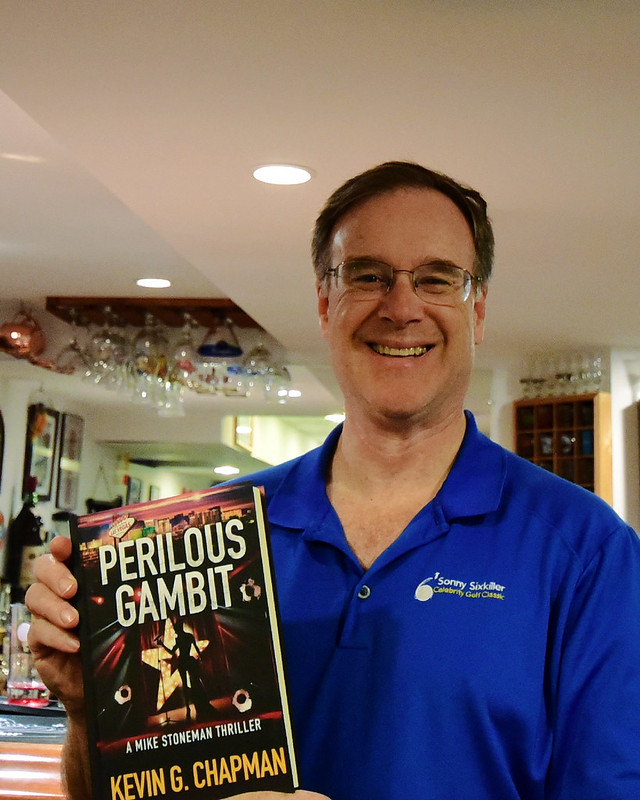
Perilous Gambit (Mike Stoneman #5) (2022)
Fatal Infraction (Mike Stoneman #4) (2022) [#1 Police Procedural of the Year — CLUE Award Blue Ribbon 1st in category]
Lethal Voyage (2021) (Mike Stoneman #3) [Winner! — 2021 Kindle Book Award]
Deadly Enterprise (Mike Stoneman #2) (2020)
Righteous Assassin (Mike Stoneman Thriller #1) (2018)
A Legacy of One (Literary Fiction) (2016; 2nd Ed. 2021)
Fool Me Twice (Mike Stoneman Short Story)
Podcasts and Interviews:
Amy’s Bookshelf Podcast (Jan. 18, 2026)
Author in the Headlights (Jan. 13. 2026)
KONP Newsradio 1450 w/ Todd Ortloff (Jan. 8, 2026)
Hidden Gems Indie Author marketing podcast (1.2.25)
ALLi inspirational authors podcast (12.22.24)
Kevin on the Todd Ortloff Show (KONP Newsradio) 12.2.24
Author in the Headlights podcast (12.14.24)
Breezin’ with Bierman (podcast 2.15.24)
The Author’s Lounge with Tom Riddle (April 2024)
Author in the Headlights (podcast April 2024)
Kevin on the Todd Ortloff show, Jan. 4, 2024)
The Baseball Lifer with Don Wardlow (podcast 11.17.23)
Authorsphere with Dan Alatore (podcast 12.12.22)
Radio Interview (Nov. 30, 2022), (talking about Dead Winner and the future of the Mike Stoneman Thriller series)
National Leage Town Podcast (Nov. 17, 2022) (talking Mets baseball and Dead Winner)
Behind the Books Podcast (Nov. 16, 2022) (Local library podcast talking about the release of Dead Winer)
Author Your Dreams podcast (Dec. 8, 2021) (talking about self-narrating audiobooks)
Radio Interview – Dec. 4, 2021 — KONP NewsRadio 1450 (discussing Perilous Gambit)
Read & Write Podcast — Oct. 13, 2021 (discussing the development of characters in my crime-thriller series)
The Douglas Coleman Show — July 12, 2021
Radio Interview — KONP Newsradio 1450 — Nov. 23, 2020 (discussing Lethal Voyage)
Interview on KONP – Dec. 2, 2019 (Deadly Enterprise Launch Day)
Interview on KONP – March 19, 2019 (Righteous Assassin):
Trip Elix Podcast Aug. 20, 2020 (discussion of indie publishing)
Radio Interview – KONP Newsradio 1450 – July 27, 2021 (discussing Fatal Infraction)
GET IN TOUCH
You can contact Kevin at KevinGChapman [at] gmail.com or via this website’s contact page.
Articles and Blog Interviews
Literate-ly Magazine (“Yes, You can narrate your own audiobook” Part 1 of 3)
InD’Tale Magazine — April 2021 — (“The Value of Beta Readers and Sensitivity Readers“)
Mystery & Suspense.com — Locked Room Murder Mysteries, Nov. 2, 2020
InD’Tale Magazine – June 2020 (“My Self-Narrating Journey -part 1”)
InD’Tale Magazine – July/Aug 2020 (“Self-Narrating — avoiding the mistakes I made – part 2”)
InD’Tale Magazine – May 2020 (“Editing your own writing”)
Interview on BookPleasures.com — October 2021 (with notes about Perilous Gambit)
Fiction with a Touch of Reality (Louse Wise) [April 2020]:
Mary Woldering (2019): [part 1] [part 2]
Author Blogspot (2020)
Awesome Gang (2019)
E-Author Resources (Deadly Enterprise)
Nostalgia CIty Mysteries (Nov. 15, 2021) Guest Blog (Un-British character nearly sinks new novel)







Interviewer: How did you develop the idea for The Other Murder, and what inspired you to explore the intersection of media, law enforcement, and personal biases in the narrative?
Kevin: I’m a lawyer who works for a media company and writes crime thrillers, so the three most significant elements of my professional life all come together in The Other Murder. The story sprang from my non-original observation that pretty, affluent White girls who are missing or killed tend to dominate the news cycles. We often hear statistics about the number of murders and violent crimes in a particular city, but seldom (if ever) see significant media coverage given to a minority victim who isn’t rich and famous. This phenomenon, could be called “unconscious bias,” but is likely more a conscious choice by producers and media executives to feature stories that will tend to get the biggest ratings. Particularly in broadcast news, including 24-hour cable news networks, getting eyes on your story is the most important thing. The story that can be made sensationalistic and which involves a victim that your viewers will sympathize with and relate to is the story you feature. That’s good economics, but leads to a slanted presentation of the world. I wanted to make this murder mystery a story that gets inside that culture and lets my readers see all sides of the story as it unfolds.
Interviewer: The story involves two journalists and two homicide detectives. How did you approach developing these characters, and what challenges did you face in creating complex relationships between them while navigating the intricacies of the murder mystery?
Kevin: The real “leads” of this story are the two journalists. Each of them has positive and negative attributes and each makes choices that are both selfish and noble – the two being not mutually exclusive. I wanted my cable news producer to be understood in the context of her job, her bosses, and her ambitions. I wanted the print journalist to be understood as someone who could have a “better” job, but who has a calling both to journalism and to his community. Their interactions disclose their similarities and differences as well as the nature of the business in which they work. And, of course, it’s a murder story so there must be cops. Here, the cops don’t have all the information and need the help of the journalists. The two partners have their own problems, including a recent incident that set them at odds. Through their eyes, the reader learns things the journalists don’t know and sees the way the media coverage affects the police investigation. Making the characters the focus of the story lets me tell the mystery story through interesting eyes.
I have always loved the mysteries of Sara Paretsky, whose characters are the heart and soul of her books. In the Mike Stoneman Thriller series, I had a fixed set of main characters to be my narrators. They, and their minor-character companions, gave me a universe of backstories to weave into the mysteries. Here, in this stand-alone story, I had to create brand new characters and get my readers to relate to them and care about them. My goal, like Ms. Paretsky, is to make my readers as interested in the stories of the players as they are about the underlying “main” plot. The plot needs to hold them together, but the characters need to behave in a way that is both realistic and interesting.
I’m always disappointed in a book when the characters are stupid, make irrational decisions (for the sake of advancing the plot), and where the logic of the story doesn’t hold together. I want my plots to make sense – in the context of the fictional facts. This past year I read a best-seller called Just the Nicest Couple, by Mary Kubica, who has a big publisher and whose new book sold a zillion copies based on her stellar reputation. But the plot was a mess, the characters made nothing but bad decisions, the key bits of information made no sense, and the ending was entirely unsatisfying. And, along the way, none of the characters were likable. I didn’t care whether they all ended up dead or in jail because they were all idiots. I’m hoping nobody thinks that about The Other Murder.
Interviewer: How did you handle the portrayal of racism in the novel, and what message do you hope readers will take away from this aspect of the story?
Kevin: The main plot here involves the subtle racism that permeates the media and, to some extent, the police and the city officials, who are driven by publicity (positive or negative) and public perception. When the media tells the public that a situation is a horrible tragedy and an example of a huge problem that needs to be fixed, crowds gather, memorials are created, politicians and activists make speeches, and the media feeds on itself to amplify the story. Government officials like the mayor and the police commissioner react by making that crime a priority and devoting resources to solving it. Catching that killer matters because everyone is watching. In this story, the second murder involves a Latino boy with a history of gang membership. It garners no media attention and would have generated minimal police interest – until the cops discover that Javier Estrada’s murder may be connected to the White girl, Angelica Monroe. The immediately reported story is that Angelica was an innocent victim of urban gun violence. She becomes a saint. Javier Estrada is ignored.
Meanwhile, the two detectives on the cases are a White man and a Hispanic woman. Mariana is the only character involved in the police investigation who cares about Javier’s story. Similarly, only Paulo Richardson, the local newspaper reporter, cares about Javier’s portrayal in the press. Paulo wants to make people see the truth about Javier. Mariana wants her colleagues to see that the White girl isn’t always the victim and the Latino boy is not always the criminal. The investigation also lays bare the recent rift between Mariana and her partner, Dru Cook, arising from an incident of police brutality. Was that incident racially motivated? Dru didn’t think so. Mariana saw it differently.
In the end, once the reader has all the facts (or, at least all the different versions of the facts), the question of who is a little bit racist and where motives and biases get mixed together makes things a lot less clear cut. My hope is that the reader not only enjoys the story and cares about the characters, but that the tale makes them think a little bit about their own perceptions.
Interviewer: The story involves two murders on the same night—one garnering intense media attention and the other mostly ignored. How did you balance the narrative between these two cases, and what narrative choices did you make to ensure both stories were effectively told?
Kevin: It was fun weaving together the four points-of-view in the story. Through each one (and the two detectives are one joint POV), the reader has more information than any of the individual characters. I had to deconstruct the story at one point and separate out each POV into its own sub-story to make sure that all the events and facts stayed straight. When the POVs collide at different points in the book (and all of them together in the climax), it was a juggling act to make each story compelling while allowing the reader to “view” the action in a coherent way so that it all made sense. It was even more of a challenge when narrating the audiobook, where I was jumping back and forth between the voices!
Part of the challenge was making sure there was enough of a mystery for the reader to try to figure out, and how to keep them guessing.
Interviewer: The novel challenges readers to guess what happened, indicating mystery and suspense. How did you craft the tension in the narrative, and what techniques did you employ to keep readers engaged in solving the mystery?
Kevin: In the first draft of the story, chapter one gave the reader a view into all the events that happened leading up to and including the murders of Angelica and Javier. I’ll be publishing that chapter as a “deleted scene” on my website after the book has been out for a while. I realized after the first draft was done that letting the reader know what happened and then following the investigations by the police and the journalists with that knowledge was not fully satisfying as a mystery. The story was: “how are they going to figure it out?” rather than “what happened?”
So, I went back and deleted most of that first chapter and re-wrote the story so that the journalists and the police (along with the reader) are piecing together the facts, without knowing for sure who is giving them good information, which of their assumptions are correct, and what information they are missing. This allows the reader to guess where the characters have it right, and what might be wrong. Even at the end, nobody (including the reader) can be 100% sure they know the whole truth.
Elements of the plot changed to the point that I sometimes got confused about what had happened in the earlier chapters of the current version. I had two of my typokiller readers point out where one of the characters made an important observation – that was not true in the version of the facts that they could have known. (Thank you to all my typokillers and Beta readers!)
Interviewer: The novel highlights the danger of the truth. Can you elaborate on the significance of this theme and how it plays into the challenges faced by the characters, particularly Hannah and Paulo, as they uncover disturbing facts?
Kevin: The tag line of the book was one of the first things I wrote after outlining the basic story. “Sometimes, the most dangerous thing . . . is the truth.” It is a common observation that humans are significantly influenced by what is called in psychology “recency bias.” Your strongest memories and emotions are attached to the things that happened most recently. It is also true in media that the first story is the one that gets imprinted in people’s memories, particularly if it sparks strong emotions. When asked whether one of two things is true, the one you heard first is the one you are more likely to believe.
One of the core messages of The Other Murder is that people need to be careful about believing the first narrative they hear. But the reality is that, once a set of facts is in your head, it is hard to push it out. This is especially true when the original narrative reinforces your personal views and political objectives. Telling people who are emotionally, financially, and politically invested in one version of a story that the story they heard and want to believe is really a false narrative – is a dangerous thing to do.
In the media world, once you have established your narrative and “hooked” your audience, it’s hard to switch gears and retain your viewers if you suddenly try to tell them that what you had been telling them is false and that there’s a new truth they should switch to. They are likely to switch – to a different news source that will reinforce their belief in the original story. That is part of the challenge facing Paulo and Hannah.
Interviewer: Where can our readers learn more about you and The Other Murder?
Kevin: The Other Murder is now available (as of February 29th) as an ebook for your Kindle via Amazon.com at https://www.amazon.com/dp/B0CJN6W5NJ. Amazon can also sell you a paperback or a hardcover. Paperbacks and hardcovers are also available through select independent bookstores and via Bookshop.org, which supports local bookstores. The audiobook version is available via CHIRP, iTunes, Googleplay, Roku, Nook (Barnes & Noble), LIBRO.FM (which also supports independent bookstores) and on Audible. All my other titles are also available at all the same retailers. Readers can contact me and see all my content at https://www.KevinGChapman.com.
Media Interview Questions re: The Mike Stoneman Thriller Series (general)
{updated 6.30.21}
How did you get started writing this crime-thriller series? A long time ago, in the mid-90s, I wrote my first novel, which was a mystery starring a New York Private Investigator named Rick LaBlonde. It was fun and a good try at a first novel. But it was before Amazon and before self-publishing was really a thing. I put it aside in about 1996 when I couldn’t get any interest from a publisher. Then, in 2002, my wife told me that for our 20th wedding anniversary, she was going to pay to have the book published by a new company that had come into existence called Xlibris, which was a division of a big publishing house and which was an early “vanity publisher” that would essentially allow you to self-publish a book. In those days, you had to order a minimum number of copies for printing. It was a lovely present, and I still have a few copies of that first book left on my basement shelves.
But by then I had a new job and three kids and I didn’t do any more real writing for many years. Then in the mid-2000s (the aughts?) as my kids were getting older, I got the itch again and I started working on my version of The Great American Novel. It was very, very loosely based on some autobiographical events in my life, but was mostly just fiction. It’s about a conservative Senator who has to confront his past and make hard decisions about his future. It’s about morality and politics and self-determination and identity. It’s a very serious book, but with some interesting characters and, I think, a compelling story line. It’s called A Legacy of One. It got some great reviews and some book award recognition, but didn’t sell. Part of that was my own lack of understanding about how marketing a self-published book worked in the new Amazon age, but it’s also because the subject matter isn’t particularly popular unless you’re already a well-known author or celebrity.
I spent 10 years off and on working on that and finally published it in 2016. When the dust cleared from that project, I decided I still wanted to write, but I needed to get into something more fun, less serious, and hopefully something more marketable. Along the way, in 2012, I had written a short story for a writing contest where the subject had to be crime or law. I had created a character named Mike Stoneman, an NYPD homicide detective. The short story, called Fool Me Twice won first prize in the contest. So, in 2016, I decided to take that character from the short story and work him up into a full-blown crime fiction novel. The short story is now available for free on Amazon and other sales platforms, and I included it as an extra feature at the end of the first book in the novel series, Righteous Assassin.
Can you describe your main characters? Mike Stoneman is a veteran homicide detective in the New York Police Department. In addition to being the senior detective on his team, he also teaches classes at the police academy and separate night classes for cops studying for the detectives exam. His classes are on things like evidence handling, crime scene protocol, witness interrogation, and how to testify in court. He typically gets assigned the new detectives so he can show them the ropes. He likes that work – teaching the younger cops and passing down his wisdom. He loves it when other cops come to him for his opinion on a tough case.
He’s also a Mets fan and likes classic rock music. He wears plain slacks and sports jacket combos with non-descript ties and comfortable (old) shoes. He’s not flashy – he’s not trying to impress anyone. He’s just turned 50 and is a little overweight, but trying to work out more and get into better shape, especially since he has become romantically involved with Michelle McNeill, the county medical examiner. But, he likes his pasta. He also appreciates a fine single-malt scotch.
Mike’s partner, Jason Dickson, is an African-American detective with a military background. He’s young and smooth and confident – but a little too cocky sometimes for Mike’s liking. There is some tension between them in book #1 (Righteous Assassin), but by book #2 (Deadly Enterprise) the partners fully have each other’s backs. In book #3 (Lethal Voyage), Jason takes more of the spotlight along with his girlfriend, Rachel Robinson. Their romance, which was briefly mentioned in book #2, becomes the emotional core of book #3.
The dynamics between Mike and Jason and their relationship, as well as the relationship between Mike and Michelle and between Jason and Rachel, are the heart of the stories. The Jason/Rachel story line gets big play in book #4 (Fatal Infraction), and will play a big part in book #5 (Perilous Gambit), which is due out in late 2021.
What makes them original? Mike and Jason are both complex and “real” people. Neither is a super hero who takes on multiple attackers barehanded or outthinks an evil mastermind, or smoothly seduces the female spy. They are vulnerable and awkward and emotional. Their comrades in the precinct are similarly “normal” people who banter and argue and yell. They are very much New York-based people and I try to give an authentic feel to their surroundings and stories. Mike’s status as the mentor and senior detective give him a unique persona and perspective.
The relationship between the middle-aged couple, Mike and Michelle, starts out slow and then settles into a very comfortable ongoing romance, but they deal with their own issues. Jason and Rachel are younger and the discussion about whether to get engaged is a big topic, along with what it means to be married to a cop – and what it means for Jason to be a cop and also a husband and father. They are murder mystery stories, but the characters draw the reader into a real world, not a big-budget movie fantasy.
What makes them tick? Mike is a very by-the-book guy for the most part, but we learn in all the stories that he’s willing to bend the rules when he feels that it’s necessary or justified. He also is concerned about his relationship with Michelle and how to keep that going, without putting her in danger. He’s also (surprisingly) concerned about Jason and his future and well-being. So, he’s both a crusty jaded cop and a sensitive, concerned person. He’s also now concerned about his own mortality and his own future to a degree that’s new to him, after 24 years on the force.
What is their biggest fear? Now, Mike’s biggest fear is that something bad will happen to Michelle because of one of his investigations. It nearly happened in “Righteous Assassin,” and it became an issue between them in “Deadly Enterprise.” Unfortunately for Mike, there is more peril ahead for Michelle.
Is there a consistent bad guy in the books? No. Each book has its own villains and challenges. Not every situation is clear-cut, which makes it fun. There is no super-villain who keeps coming back to terrorize the City. Each story is very unique.
Can the books be read in any order? Each book is a fully stand-alone story. I’ve had many readers pick up the series at each point and nobody has had any problems enjoying the books separately without having read the earlier ones. But, there is some development of the characters going on, and there are references in each book to events that happened in the earlier books. Some are necessary for later readers, and some are Easter eggs for readers who will get the “inside” jokes. There’s not much of that, but enough to make my audience happy. But they definitely can be read in any sequence. Book #4 in particular is a very self-contained story that requires no knowledge of what happened in the earlier books to enjoy.
If you and your character met in real life, do you think you’d get on? Oh yes! I have given Mike many character traits from my own backstory. We would definitely go to a Mets game together and then share a high-end single malt. Mike’s a little younger than I, but we are both Boomers and share a lot of common experience. I’m not a cop, but that wouldn’t stop us from being friends.
Who would you like to see play them if your books were made into a film or TV show? In the movie version of Righteous Assassin, if it were made soon, Michael B. Jordan would play Jason. Mike is a tougher call. Maybe Russell Crowe or Brad Pitt. Two decades ago, I would have said Charles Durning, but he’s too old now.
How many books do you have in the series so far? Books 1-4 are published and available in hardcover, paperback, ebook, and audiobook editions. I narrated the audiobooks myself. Book #5 is in production and I hope to have it available for sale by the end of 2021. That will make it a 5-book series in just about three years. Not bad for somebody with a day job.
What’s in store for them next? At the end of book #4 (Fatal Infraction), Jason has just proposed to Rachel (spoiler: she says yes). They are just back from their adventure in book #3 aboard a cruise ship and how have dealt with the murder of a Black NFL quarterback. They could use a rest. Book #5 will pick up in late 2020 and will involve a trip to Las Vegas. It will end before the end of January, 2021, so right before the COVID-19 lock-down. At that point, there will be a lull in the story. Book #6 (if I decide to keep going) will be set sometime in 2022 or maybe even 2023. I won’t give away anything about the plot of book #5 except to say that a few old characters will make appearances. Book #5 will be the end of a story arc for the characters, but there’s plenty left for them in the future.

 kevingchapman.com