“As a jumping off point for discussing these significant social issues, the book is a success. But as a story about Stephanie, the book misses the emotional mark and it is structurally challenged.”
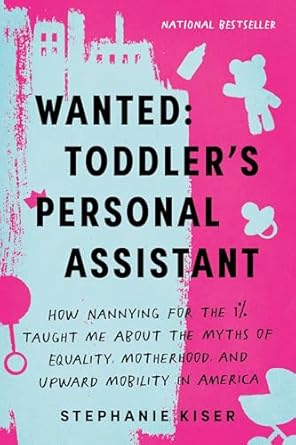
Ms. Kiser’s memoir (a book club read for me) succeeds in raising many important social issues through her journey working in her twenties as a nanny for the uber-rich in New York City as a means of supporting herself and paying off her student loans. Start with the fact that she graduated from college burdened with heavy load debt that she could not repay on the salary of an entry-level college graduate job. Then move on to the stark contrast in living conditions between the very rich (who have money to hire a fulltime nanny) and those who provide the essential services of their opulent lifestyle. The author’s experiences included some “nice” rich employers and some true horror stories. Even the relationships among the nannies raises issues of class and social ostracism. Throw in Stephanie’s love life, an abortion, a break-up with her long-time friend and roommate, her feelings of isolation, her discovery of Hillary Clinton and progressive politics (after being raised in an ultra-conservative household) and her complicated relationship with her family, and you have a ton of fodder for discussion. And that’s even before you get to the Covid-19 pandemic and how it affected the nannie set and Stephanie in particular.
As a jumping off point for discussing these significant social issues, the book is a success. (And it seems at times that the author is specifically including content with that purpose.)
But as a story about Stephanie, the book misses the emotional mark and it is structurally challenged. Threads of story and characters pick up and end without reason, only to reappear again much later. Large gaps in time are not well explained. Stephanie (for no logical reason) decides to buy a puppy a week before moving into a new apartment she is going to be sharing with two new roommates, while her job will keep her away from the apartment for 12-hour days — yet there is no mention of how that disaster-in-waiting worked out. Then there is no mention of the dog for 100 pages, when it reappears (now with a name) and then fades away again as if never really important.
The story is mostly chronological in the present day chapters, following Stephanie’s education about being a nanny, then moving on to a new gig, then another, etc. There is plenty happening, but mostly it’s Stephanie whining about not being fulfilled and happy with her lot in life, despite earning a lot of money and living in the lap of luxury (albeit with screaming children). There is no consistent thread that joins the episodes of Stephanie’s life, nor any particular point to the story aside from how “hard” Stephanie had it adapting to the nanny role, and how hard it was to leave a group of children after bonding with them.
I found Stephanie not very likeable, and other were no other characters you can really feel good about, which made it a difficult read. Then, the end was not particularly satisfying either.
There are also some technical issues — more copy editing/typos than you would expect in a professionally edited text, and the constant switching between (mostly) first person present narrative in the current-day sections and past tense flashbacks to earlier years. Often this is a distraction.
Overall, there were interesting issues and some interesting stories, but as a whole book I found it lacking. But, as a book club spark for discussion of social/economic/political issues — it’s a fine way to get the ball rolling.

 kevingchapman.com