“If you enjoy world-building and immersing in a fantasy world with engaging detail and likeable (if sometimes bumbling) characters, you can hunker down for a good long spell of being fascinated by the world of Rhone and Stone.”
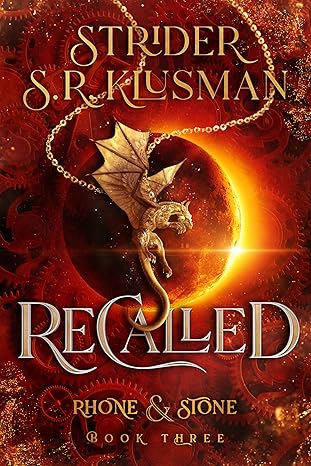
This was my first exposure to Strider Kussman’s Rhone & Stone series. The author gave me a complementary copy and these are my honest thoughts about this fantasy/adventure novel.
Rhone is the male protagonist, a young, inexperienced “agent” of the OPR, a government agency dedicated to generally doing good. Despite this being the third book in this series, Rhone is woefully deficient in his swordplay skills and general savvy. He would be utterly lost without Stone – his mysterious crystalline entity that exists inside a jewel embedded in Rhone’s collar. Stone, an ancient entity, communicates telepathically with Rhone and is clearly the brains of this partnership. The relationship between Stone and Rhone – as well as the connection between Stone and another of his extra-human companions – is the heart of the story.
This fantasy adventure is set in a world of swords, arrows, castles, and horses, but the technical acumen of Stone and his kind allow Rhone to develop technology that advances their causes. The frequent anachronisms, both in plot items and language, give the story an extra-temporal feel, similar to steam-punk. It is not a romance (at all), relying on Rhone and his cadre of supporting characters to carry the action.
The plot involves a group of five brothers, squabbling over the division of their father’s fortune and holdings, while they attempt to influence the local politics as “the brotherhood.” The five have unknowingly split up a different jewel containing a supernatural entity like Stone. Their individual rings containing fragments of the original jewel give them some advantages in their business and political aspirations, but they are not fully clued-in to the significance of their father’s “amulet.” Meanwhile, Rhone’s organization wants him to investigate whether someone (like the Brotherhood) is influencing The Council – the official body of what is presumably a democratic-like government. Rhone and Stone seek out the answers and find themselves in mortal peril as a result.
Without spoiling anything, Rhone’s efforts to create some new technological aids, his newfound relationship with a former agent named Lev, who first attacks him, but then befriends him, and his relationship with his boss – the head of the OPC who thinks of him as a surrogate son, drive the narrative. The prose here are rich and resplendent as the author paints a word painting of his world and the characters. The plot develops slowly, but the characters – and in particular the reader’s curiosity about the true nature of Stone and his supernatural companions – keeps the pages turning.
If you enjoy world-building and immersing in a fantasy world with engaging detail and likeable (if sometimes bumbling) characters, you can hunker down for a good long spell of being fascinated by the world of Rhone and Stone.

 kevingchapman.com