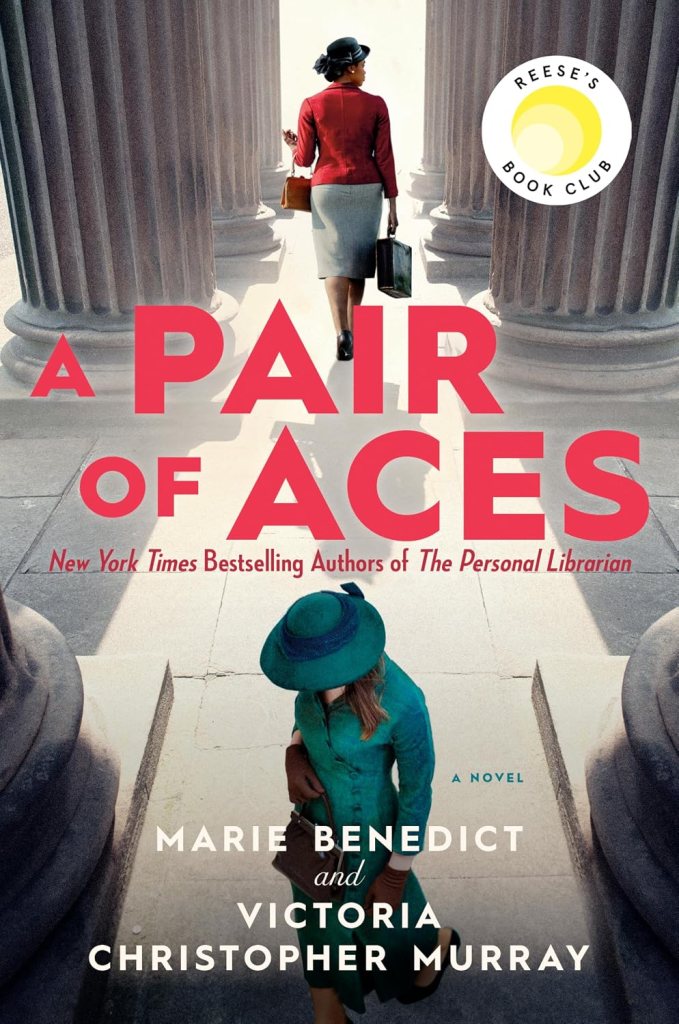
“If you love historical fiction, love detailed narration of scene and mood, love seeing famous names dropped into the story as cameos, and don’t mind that the payoff is scant, you may love this book. For me, it was meh.”
Historical fiction is best when it reveals events the reader does not already know about, recounts known events in a freshly compelling way, and provides interesting characters whose fictional roles are independently worth reading. A Pair of Aces ticks the first box by chronicling the story of how mob boss Charles “Lucky” Luciano was convicted and sent to prison – not for murder or loan sharking or drug running – but for organizing New York’s brothels into a money maker for his crime syndicate. And one of the prosecutors involved in the 1936 was a Black female attorney named Eunice Carter. It is a story I did not know and it was interesting.
But authors Marie Benedict and Victoria Christopher Murray miss the mark on the other key metrics. The book does not make the historical events from compelling, and the fictionalized versions of the two main characters are not particularly interesting. It’s a slog through the narrative, likely much less worth your time than reading the biographies and the autobiography of the infamous madame, Polly Adler, that was the source material for these authors (explained in two Afterwards). The novelization isn’t as dramatic as the real events.
This book is not bad. It contains heaps of description and paints a lovely picture of the time period. The two first person present narrators spend most of their time inside their own heads, explaining what they are thinking and feeling, and observing the events around them. It’s fine, but not gripping.
Polly is the more interesting character. Her life as the Russian Jew who came to the US at age twelve and eventually became a high-class madame has some fun moments. The authors drop in names of famous people of the day, including placing members of the Algonquin Circle in Polly’s brothel – including Robert Benchley and Dorothy Parker – because her King Tut bar (a real thing!) was the cool place to be. (The famous writers had moved to Los Angeles by the time the events of this story unfold, so the name-dropping is entirely gratuitous. They play no part in the fictional story.)
But Polly’s story here is bland. She fictionally becomes an inside source for Eunice Carter in order to protect her business interests. Luciano’s mob is skimming her profits, encroaching on her independence, beating up her girls, and turning her famous bar into a den of thieves. To free herself from the mob, she turns snitch – although she lacks the courage to testify herself, despite having personally overheard Luciano giving the order to kill a rival gangster. She leaks enough to help Eunice, but not all she has. In the end, her tips provided vital information, but Polly is no hero. The brief fictional interaction with her disappointed parents does little to round out the character. She is rich and infamous, she hobnobs with the cream of society, and she acts out of self-interest. She wants to protect her girls, but gladly sends them out to turn tricks for her. She and Eunice meet only a few times. We feel happy that Polly will be able to re-open her brothel, but it’s not a moment that has any emotional impact.
Eunice could have been a fascinating story in her own, but never is in this book. She experiences no discrimination, or hardship, despite an environment where it should happen daily. She overcame being a Black woman to become a lawyer and a prosecutor, but in this story she wanted to be a writer, then a social worker, then she went to law school as a lark and wasn’t really sure what she wanted. She is also rich, privileged, and married to a prominent dentist and community leader. Likely true facts, but they don’t make her someone who overcomes obstacles. The story makes it seem like she never would have succeeded without the happenstance of Polly’s help.
The thin attempt to create marital strife based on Eunice being too focused on this one prosecution never creates real tension. (The bit where Eunice forgets about and misses the huge NAACP gala dinner where her husband receives a major honor and award was simply unbelievable.) She faces fear that the mob will come after her, but it never happens.
Three-quarters through the story, Eunice waxes philosophic about how her very privileged life had not been fulfilling to her until she took the job on the organized crime task force: “I’m not saying that what I’m talking about is equivalent to the emancipation that my grandfather and the other slaves received . . . I”m thirty-six years old, and for the first time, I feel like I’m not bound by any chains.” Her friend (who appears in the story solely for this vignette), says “”In just these few minutes, you’ve given me a lifetime of lessons . . . I hope one day to be as brave as you, so I can be free, too.” This is, apparently, how the authors wanted us to feel about Eunice. It’s a stretch.
There are no other characters. DA Thomas Dewey (yes, that Dewey) is not fleshed out at all and provides no significant interaction with Eunice. She has no other colleagues of note on the team and seems to be acting entirely alone. She is fighting heavy odds, but there is never any manifestation of her beating them.
The trial scenes are boring and lack suspense. Luciano’s guilt is never in doubt and when the jury comes back with a guilty verdict in only four hours on sixty counts (just so Polly can be there) is no climax. (Especially when Dewey calls it an “indictment” instead of a verdict.)
The prose in the story is lavish, but contains more copy editing errors than I would expect from a Penguin Random House book from a best-selling author.
Overall, the nearly 400 pages meandered by, chopped into many short chapters, each indicating the character narrating and the date. (The authors sometimes over-assume that the reader is paying close attention to the date and remembering the date of the last chapter in order to perceive how much time has passed.) Nothing special. Not bad, but I was mostly waiting for something interesting to happen that never did.
If you love historical fiction, love detailed narration of scene and mood, love seeing famous names dropped into the story as cameos, and don’t mind that the payoff is scant, you may love this book. For me, it was meh.
I read this book for a book club meeting. I’m happy I read it and learned about Eunice Carter’s story. We read The Personal Librarian (an earlier historical fiction by the same authors), which was a better story. In this case, the authors seemed overly constrained by the historical facts and could not come up with a good enough fictional story.


